.jpg)
Abram K-J, blogger, is announcing a soirée. To use his words precisely, he's "Announcing the Septuagint Studies Soirée." In "the" party, he's announced the "four Septuagint-related blogs" that he knows of.
All men authored, these four. Which was some the point of this little blog, Septuagint-related as it was from the get go.
I'm interested in readings of the Septuagint. In readings as the Septuagint. In what translation has done, in what Greek has done, in what Jewish people have done with their own Scriptures when confronted in legend with what the goyim leaders commanded of them, in what men have done.
Evelyn Underhill paraphrases the man Dante. She says, and I quote her directly:
"Dante warned the
readers of the Divine Comedy that everything in it had a fourfold meaning.... This, which is indeed true of the Comedy, is far more true of the great statements of the Christian religion."
Underhill ignores the fact that Dante was writing literally to another man. She sidesteps the issue that he was actually writing to him concerning how to read, the meanings available from, the following:
In exitu Israel de Egypto, domus Iacob de populo barbaro, facta est Iudea sanctificatio eius, Israel potestas eius
Now, most readers who don't even read Latin will recognize the fact that the above is a mere translation. It is not an original. Or, at least, literally we might all concede that it is not "the" original. It's a Soirée.
That may well be what the Septuagint is.
If we step back from the man Dante writing for another man, and if we consider the translation called the Septuagint, by men for other men, then we don't really know what to do with it.
I don't. I did try to read the Greek translation once upon a time as poetry. I struggled with whether the first line should begin “In the ExOdus of…”
Interpretive spins and literary sparks, perhaps, is one way to focus on what turns out of the Septuagint as "the" Psalmoi. So here I've been doing a series of blogposts on that, for example, here.
If we men will not concede that we are barbarians kept out of this translation called the Septuagint (or kept out by this translation), then I'm not sure how good our logic is.
Going back to the particular Hellene version of the particular bit of Psalm Dante troubled over in four-fold and Christian ways in Latin, I think we all might concede it talks about us, but not in the ways we necessarily want it to. It calls us Barbarians, and rightly so:
αλληλουια
ἐν ἐξόδῳ Ισραηλ ἐξ Αἰγύπτου οἴκου Ιακωβ ἐκ λαοῦ βαρβάρου
I think "the" ExOdys is a key to positioning who is reading the scriptures as whom and how. If you "understand" the Greek, then maybe the point of that Greek is that you cannot really "get" it. (Sometimes that understanding, those misunderstandings, deserves a quick post. Other times it requires an entire blog on the Septuagint, or now "the Septuagint Studies Soirée.")
So I'm just going to end this little post by recalling how the first post of this blog ended. It's a little four-paragraph history of the Septuagint melded with my little history of a soirée. Who knows when it will end? At midnight? With the rosy-fingered dawn? I don't even think I was invited to the party, unless you rightly call me a barbarian, an outsider to the Septuagint, if also a man.
1. Jewish men began translating their Hebrew text into the Hellene mother
tongue in Alexander the Great's Alexandria, Egypt in around 246BCE.
2. In
many fascinating ways, this act of translating into Hellene opens up
the text. It opens the text up into the debates over how Greek males
(such as Alexander's teacher Aristotle) may control the Greek language
for elite educated men of the Academy. The language control was to
exclude not only women but also sophists, rhetoricians, ancient epic
poets, more contemporary poets, colonists such as those in Soli who
committed "solecisms" in writing, and BarBarians who spoke in foreign
barbarisms.
3. The intended or unintended wordplay in the
newly-translated Greek Jewish Bible (or ἡ βίβλος), and how such
translatings allow women, or wombmen, to overhear the text as outsiders,
are some of the focuses of this blog. In this blog, I'm also going to
look at the New Testament (or new covenant) written by Jewish men using
the Hellene mother tongue as their male text.
4. So it's "The womBman's Bible: an outsider's perspective on the Hebrew male's Hellene book."
Sunday, August 4, 2013


Monday, December 24, 2012
Friday, December 21, 2012
Tuesday, December 18, 2012
Wordplay Translation in Greek Isaiah 3:1?
-----
UPDATE: And on facebook, this:Bob MacDonald - While I like the pointing out of such things and the play of language, it seems to me this is more of an accident than design in this case - what might be said though about the words with ἰσχ in them - several in a row. Are these related to support (mainstay, staff) or to shame in Greek - or is this also an accident? Also is there a difference between LXX and NT Greek over the 300 years(?) between them?
Me - Bob, there are so many such "accidents' in the LXX that we begin to suspect them on purpose. The proliferation of the initial Pi in chapter 1 verses 4, 5, 6, 7, 8, and 21, for instance, makes the paraphrasing sound perhaps plenty like the opener to the Odyssey on accident or or purpose. Who can, this far out, know the author's or translator's intentions?
Bob MacDonald - The use of mem in audible lip-smacking form is I think in Psalm 73:10. וּמֵי מָלֵא יִמָּצוּ לָֽמֹו; Greek (72:10) seems to have no lip-smacking in its imitation καὶ ἡμέραι πλήρεις εὑρεθήσονται αὐτοῖς. I read this as a sneer from the rich who delight in exploiting the poor - fully milking them to get the lip-smacking intent in it. I'd like to hear this beyond an initial iota - so K [that's me] - allowing this as deliberate - can you comment on the 2nd half of my question -or even the third half :)
Me -
Bob - you ask "Are these [ words with ἰσχ in them - several in a row] related to support (mainstay, staff) or to shame in Greek - or is this also an accident?"
Funny you should ask. There's a humorous (maybe vulgar) answer perhaps.
There's a humorous (maybe vulgar) answer perhaps.
How much might the Greek translator in Alexandria have known of the plays of Aristophanes? Is he with Greek Isaiah 3:1 somehow invoking one of the playful lines of the play The Acharnians (around line 590)?
In Greek, that line reads like this (but I warn the readers here of the vulgarity in the humor) with a reference to circumcision (which is of interest to all readers of Torah) -
οὐ γὰρ κατ’ ἰσχύν ἐστιν· εἰ δ’ ἰσχυρὸς εἶ,
τί μ’ οὐκ ἀπεψώλησας; Εὔοπλος γὰρ εἶ.
Here are three different English translations of that Greek (again, a warning to the reader here) -
"Violence is out of place here! But as you are so strong, why did you not circumcise me? You have all the tools you want for the operation there."
[from Perseus online - "Aristophanes. Acharnians. The Eleven Comedies. Anonymous. New York. Liveright. 192?"]
"That’s not your forte! Your forte is to decapitate pricks. (He brandishes his phallus) Here! Come on, do mine… if you’re so strong! You’ve got all the tools you need! Sword, spear, shield, feathers…"
[trans. by George Theodoridis]
"I don't doubt that you're strong. Though if you are, why don't you skin my cock? You're well equipped."
[trans by Jeffrey Henderson;
Henderson offers this note - "An insulting double-meaning. In one sense 'skin my cock' refers to circumcision, regarded by the Greeks as a barbaric mutilation, which Dicaeopolis invites Lamachus to perform with his sword. In the other it refers to retraction of the foreskin by stimulating an erection, and 'well equipped' refers to Lamachus' stage-phallos, which Dicaeopolis (in double-meaning) professes to find arousing."]
For Aristophanes and his audiences, there is wordplay here with the ἰσχύν and ἰσχυρὸς (and no doubt this some connotes "shame" as with αἰσχύνη and καταισχύνῃ).
But who can say whether the Jewish translator and Jewish readers of LXX Isaiah were reading into "the words with ἰσχ in them - several in a row" some strong allusion "to circumcision, regarded by the Greeks as a barbaric mutilation"?
Bob MacDonald - Thanks K [that's me again] - I will bear this in mind when translating
Me - lol, Bob.
Me again -
Bob, In most languages the bilabial sounds /m/ and /p/ are the first made sense of by babies. Ma ma and Pa pa are the calls for those nearest, probably the former having some vocalized association with nursing. The /isk/ sound (as in the Greek phrases for "strength" and "shame") is much more complex and much less intimate and familial or familiar, I would guess. So the Hellene translator of Isaiah is using wordplay, even phonologically, in a much different (non "lip-smaking") way here. I don't know that we can make too much out of this. But it's certainly wordplay with sounds. And by "play" in English I think we can mean what a playwright writes that actors perform that audiences laugh or cry at; what children do on the playground; and even semantic play, as in hermeneutic wiggleroom.
---
and earlier in the day on fb, I'd wondered about this:
Thursday, December 13, 2012
Greeky "Greek Isaiah"
Suzanne asks "What do we make of the translation of dabar as logos, and torah as nomos?"
Similarly Bob MacDonald asks: "Re Isaiah 2:1, LXX seems pregnant ὁ λόγος ὁ γενόμενος, what would that second word be translating? Is ὁ γενόμενος for rhythm, or maybe acting as a relative pronoun?"
Ken M. Penner likewise asks: "It seems to me that most of the discussion so far has been regarding translation issues, i.e., the text as produced: Why this Greek, given that Hebrew? These are interesting questions to be sure. But I'd also like to see some (more) discussion of the text as received: what in the Greek text would give a Greek-speaking reader pause?"
To be sure, there is some considerably Greeky flavor added to the Septuagint's Isaiah. In particular, the two Greek phrases we transliterate as logos and as nomos are rather marked and remarkable.
Rod and Dagesh Forte and I, for example, stopped again this morning when reading together 1:9 and 1:10 again. We were trying to get to this week's group reading, but stopped again on these two verses from last week.
They read as follows (with my translation following):

If we don't Hear the Greekiness here, then I do hope we'll at least See it. We've already stated this fact:
In the Hebrew, there's no good idea that the word sperma ought to be here. The Hebrew is שריד. This means something like a left-behind remnant. In Isaiah 55:10, there is זרע, which is for σπέρμα sperma.
What I hope we'll see in the two-verse context above is how generative and Greeky-birthy this has become. A few other facts. In Greek, the sounds of sperma, and sodoma, and gomorra, are similar, with the same case endings. This may just be the linguistics, one might sigh. There's nothing new here. The Hebrew has its parallelisms. The Hellene has its grammatical declensions. So what?!
Well, the So What is that this sort of Greek construct sounds Sophistic. It's word play with Greek syntax, with Greek phonology, and with the translator's Greek lexis.
The logos of Kyrios and the nomos of Theos are, in this short context, connected to the sperma of Kyrios Sabaoth. If we didn't know better, we might liken it to Mark 4, the parable of parables of Jesus -- in which the logos is seeded, and the success, the fruitfulness, the offspring of this process depends on the Hearing! "Hear the word of the Lord ye rulers of Sodoma; attend to the law of God thou people of Gomorrha." This is how Brenton's English translates the Greek Isaiah's Greeky Greek. Sodom and Gomorrha are, we all know, dead by this time. And yet the new Sodom and the new Gomorrha are being called to Hear the logos of Kyrios, to Hold the nomos of Theos, to get the sperma of Kyrios Sabaoth.
By the time readers read 2:1, there's a clear understanding of the generative effect of logos:
Ὁ λόγος
ὁ γενόμενος
παρὰ κυρίου
πρὸς Ησαιαν υἱὸν Αμως
περὶ τῆς Ιουδαίας
καὶ περὶ Ιερουσαλημ.
By the time hearers hear 2:3b, there's a receptivity toward how things are supposed to sound:
ἐκ γὰρ Σιων
ἐξελεύσεται
νόμος καὶ λόγος κυρίου
ἐξ Ιερουσαλημ.
The two overdetermined Greeky Greek words go together in a very rhetorical and a very political way. And readers and hearers recall 1:26b (which Suzanne blogged here):
καὶ μετὰ ταῦτα κληθήσῃ
Πόλις δικαιοσύνης,
μητρόΠολις
Πιστὴ Σιων.
So how is this sophistic? How rhetorical? How political? How so very ethical? Well, there seemed to be a culture war of sorts going on in Greece, and this well may have influenced what was going on in Alexandria, the namesake Polis of Alexander the Great, disciple of Aristotle, disciple of Plato, disciple of Socrates -- opponents of Sophists such as Gorgias, Isocrates, and Protagoras. Four scholars, perhaps a fifth, get at this language/culture war. I'm thinking of Eric Havelock (and his Preface to Plato: History of the Greek Mind), Richard Leo Enos (and his Greek Rhetoric Before Aristotle), Susan C. Jarratt (and her Rereading the Sophists: Classical Rhetoric Refigured), Jeffrey Walker (and his Rhetoric and Poetics in Antiquity), and Edward Schiappa (and his Protagoras and Logos: A Study in Greek Philosophy and Rhetoric). Then there's Sylvie Honigman (and her The Septuagint and Homeric Scholarship in Alexandria: A Study in the Narrative of the 'Letter of Aristeas').
That's a lot to read, especially a lot that may seem tangential to the Greeky words of Greek Isaiah.
So let's just read one more little Greek line from Aristotle. This is from his Nichomachean Ethics. (And we might have read similar sorts of things in his Metaphysics, his Poetics, and his Rhetoric, as against the Greeky Sophists.)
ὁ γενόμενος συλλογισμὸς
ἀπορία γίνεται·
This is line 24 on Bekker page 1146a. Of course, I've broken the line in two and have bolded and underlined and italicized the font that seems salient to our Greeky discussion here. Aristotle (who invented Logic as a way of straightening out Sophistry and Sophistic Rhetorics and even Plato's Socrates's Dialectics) is here railing against Sophists. Aristotle is king of the Syllogism, of the logic of the statement or argument or logos put together as if necessary links in the chain of reasoning. A little more context, as put into English by Henry Rackham, goes like this:
Again (a, c) there is the difficulty raised by the argument [ὁ λόγος] of the sophists. The sophists wish to show their cleverness by entrapping their adversary into a paradox, and when they are successful, the resultant chain of reasoning ends in a deadlock: the mind is fettered, being unwilling to stand still because it cannot approve the conclusion reached, yet unable to go forward because it cannot untie the knot of the argument.
Rackham's translation of that little line above is what's bold fonted in the middle of this paragraph. We might read Aristotle's Greek concerning the logos of the sophists as follows:
"The syllogism they generate
gives birth to being perplexed."
So, for the translator of Greek Isaiah to write, ὁ λόγος ὁ γενόμενος, makes Isaiah sound nearly Sophistic. It's not the sort of emperial Greek that Alexander the Great or any philosopher king would have advocated. It's not the sort of rhetoric or poetics or ethical-syllogistic logic that Aristotle would have taught.
Into the ears of the hearers goes the sperma of Kyrios Sabaoth. Out of mother Polis Zion comes nomos and logos of Theos Kyrios.
And readers of and listeners to this Hellene Isaiah may get its Greeky generative effects.
Tuesday, December 11, 2012
Torah as Nomos in Greek Isaiah: And What's That Mean?
Some time ago, I wrote a post on this blog asking, "How to translate the word torah?" I showed how "nomos" in Homer's Iliad was translated by a couple of different excellent English translators. Then I advised:
Now, go back and read read Numbers 5 in the Greekish Jewish Old Testament called the Septuagint. Notice how the word torah [תּוֹרָה] has been rendered nómos [νόμος]. Notice it's associated with women differently than it's associated with men.The conventional wisdom is that the real difference is not in some application of "nomos" to women. But the critical general difference comes in the application of "nomos" to Christians, by Christians, for Christians. The New Testament is to take the Greek word "nomos" for Christians as the "Law." Christ, then, is offered in contrast to the Law.
And so, for Jewish scholars reading and/ or translating the New Testament, the issue needs addressing. Here's some of that.
First, from Lawrence Kushner's Jewish Spirituality: A Brief Introduction for Christians:


Second, from The Jewish Annotated New Testament:

Third, from Jewish convert to Christianity, David Stern's Complete Jewish Bible, his translation of the Greek letter from Paul to Romans:
14 For whenever Gentiles, who have no Torah, do naturally what the Torah requires, then these, even though they don’t have Torah, for themselves are Torah! 15 For their lives show that the conduct the Torah dictates is written in their hearts. Their consciences also bear witness to this, for their conflicting thoughts sometimes accuse them and sometimes defend themFourth, from Willis Barnstone's Restored New Testament, his translation of the same bit of the Greek letter from Paul to Romans:
When gentiles who do not possess the TorahFor each Greek "nomos" νόμος, there's "Torah."
Practice it naturally, these without Torah
Are themselves Torah. They show that the work
Of Torah is, as Yirmaiyahu writes:
..Written in their hearts.
And their own conscience also bears it witness.
So now there's the Greek word in Greek Isaiah. And what's that doing there? Is it for men or women, for the Jewish ideal of Torah or the Christian of post-Judaic Law?
1:10 - ἀκούσατε λόγον κυρίου ἄρχοντες Σοδομων προσέχετε νόμον θεοῦ λαὸς Γομορρας
2:3 - καὶ πορεύσονται ἔθνη πολλὰ καὶ ἐροῦσιν δεῦτε καὶ ἀναβῶμεν εἰς τὸ ὄρος κυρίου καὶ εἰς τὸν οἶκον τοῦ θεοῦ Ιακωβ καὶ ἀναγγελεῖ ἡμῖν τὴν ὁδὸν αὐτοῦ καὶ πορευσόμεθα ἐν αὐτῇ ἐκ γὰρ Σιων ἐξελεύσεται νόμος καὶ λόγος κυρίου ἐξ Ιερουσαλημ
What's that mean?
Sunday, December 9, 2012
plethora and plenty, the pronounced primary Pi
This post continues my reading this week of the Greek Isaiah per Abram K-J's collaborative effort.
Throughout 1:1-25, there are these initial letters Pi.
In particular, 21 is a standout:
πῶς ἐγένετο
πόρνη
πόλις
πιστὴ Σιων,
πλήρης κρίσεως, ἐν ᾗ δικαιοσύνη ἐκοιμήθη ἐν αὐτῇ, νῦν δὲ φονευταί.
But this all starts with the Greek poetic alliterations of the Pi in 4, 5, 6, 7, and 8:
οὐαὶ ἔθνος ἁμαρτωλόν, λαὸς
πλήρης ἁμαρτιῶν, σπέρμα
πονηρόν, υἱοὶ ἄνομοι· ἐγκατελίπατε τὸν κύριον καὶ
παρωργίσατε τὸν ἅγιον τοῦ Ισραηλ.
τί ἔτι
πληγῆτε
προστιθέντες ἀνομίαν;
πᾶσα κεφαλὴ εἰς
πόνον καὶ
πᾶσα καρδία εἰς λύπην.
ἀπὸ
ποδῶν ἕως κεφαλῆς οὔτε τραῦμα οὔτε μώλωψ οὔτε
πληγὴ φλεγμαίνουσα, οὐκ ἔστιν μάλαγμα ἐπιθεῖναι οὔτε ἔλαιον οὔτε καταδέσμους.
ἡ γῆ ὑμῶν ἔρημος, αἱ
πόλεις ὑμῶν
πυρίκαυστοι· τὴν χώραν ὑμῶν ἐνώπιον ὑμῶν ἀλλότριοι κατεσθίουσιν αὐτήν, καὶ ἠρήμωται κατεστραμμένη ὑπὸ λαῶν ἀλλοτρίων.
ἐγκαταλειφθήσεται ἡ θυγάτηρ Σιων ὡς σκηνὴ ἐν ἀμπελῶνι καὶ ὡς ὀπωροφυλάκιον ἐν σικυηράτῳ, ὡς
πόλις
πολιορκουμένη·
There are other Pi-initial phrases in this short context, but the ones I've marked above seem marked indeed. What's with the daughter of Zion being part of this Pi poetry?
And lest anyone doubt the Greekiness of this poetic peppering of Pi, here's the opener to Homer's Odyssey. It's a Peter Piper picked a peck of pickled peppers sort of poetry:
ἄνδρα μοι ἔννεπε, μοῦσα,
πολύτροπον, ὃς μάλα
πολλὰ
πλάγχθη, ἐπεὶ Τροίης ἱερὸν
πτολίεθρον ἔπερσεν:
πολλῶν δ᾽ ἀνθρώπων ἴδεν ἄστεα καὶ νόον ἔγνω,
πολλὰ δ᾽ ὅ γ᾽ ἐν
πόντῳ
πάθεν ἄλγεα ὃν κατὰ θυμόν, ἀρνύμενος ἥν τε ψυχὴν καὶ νόστον ἑταίρων.ἀλλ᾽ οὐδ᾽ ὣς ἑτάρους ἐρρύσατο, ἱέμενός περ:αὐτῶν γὰρ σφετέρῃσιν ἀτασθαλίῃσιν ὄλοντο,νήπιοι, οἳ κατὰ βοῦς Ὑπερίονος Ἠελίοιοἤσθιον: αὐτὰρ ὁ τοῖσιν ἀφείλετο νόστιμον ἦμαρ. τῶν ἁμόθεν γε, θεά, θύγατερ Διός, εἰπὲ καὶ ἡμῖν.
And notice that daughter posed prominently in this place of the plethora and plenty primary Pis.
Saturday, December 8, 2012
language of generation in 1:1-25 of Ἠσαῒας for ישעיה
Abram K-J, blogger, is reading "Greek Isaiah in a Year" and is with others in a facebook group collaborating in this effort. Bloggers
ἄκουε οὐρανέ καὶ ἐνωτίζου γῆ ὅτι κύριος ἐλάλησεν υἱοὺς ἐγέννησα καὶ ὕψωσα αὐτοὶ δέ με ἠθέτησαν
Next, in 1:8 and 1:9, I'm interested in the daughter and the seed:
ἐγκαταλειφθήσεται ἡ θυγάτηρ Σιων ὡς σκηνὴ ἐν ἀμπελῶνι καὶ ὡς ὀπωροφυλάκιον ἐν σικυηράτῳ ὡς πόλις πολιορκουμένη
καὶ εἰ μὴ κύριος σαβαωθ ἐγκατέλιπεν ἡμῖν σπέρμα ὡς Σοδομα ἂν ἐγενήθημεν καὶ ὡς Γομορρα ἂν ὡμοιώθημεν
In the Hebrew, there's no good idea that the word sperma ought to be here. The Hebrew is שריד. This means something like a left-behind remnant. In Isaiah 55:10, there is זרע, which is for σπέρμα sperma. So the Greek is adding something generative here, in the context of the explicit mention of the daughter. There's this idea of the soil seeded and the woman's womb seeded. This is stronger in the Greek, this ambiguity, than it is in the Hebrew. So what's up with that?
Friday, April 1, 2011
What Do You Think About Genesis 3:16?
Jay sends me a fb message asking,
... on Genesis 3:16. What are your thoughts on this verse? תּשׁוּקה αποστροφη desire, recourse, return ????My reply:
...on G3:16 ... the LXX is fascinating with its choice of ἀποστροφή. I'd compare with the choice in the nearby G4:7 (and why not ἐπιστροφὴ, as in Song of Songs 7:10)? And there's what Oedipus says to his sons as he lays dying, preparing for Hades (in Oedipus the King by Sophocles): "Ὦ παῖδες, ἥκει τῷδ’ ἐπ’ ἀνδρὶ θέσφατος βίου τελευτή, κοὐκέτ’ ἔστ’ ἀποστροφή." Are the translating Jews saying something here in G3:16? I'd say they're signaling "Eve's" or "Life's" desire ( תּשׁוּקה ) as "away from" rather than "towards" the mortal, human man? In "The Women's Bible," Lillie Devereux Blake stresses "Then follows what has been called the curse. Is it not rather a prediction?... It is a pity that all versions of the Bible do not give this word ["Life" in G3:20] instead of the Hebrew Eve. She was Life, the eternal mother, the first representative of the more valuable and important half of the human race." So, the LXX: Ζωή. The Greek translation is certainly playing with, leaving open, and opening up the meanings of, the Hebrew. What are your thoughts?Jay:
Thanks for your comments. You seem to have something more than I do. I really am puzzled. There seems something so rich here. What is happening in this curse and what is to be the eventual solution? Victor Hamilton in his commentary suggests that the LXX translators got it wrong. I don't know, but surely they had a reason. A reason to translate תּשׁוּקה as αποστροφη in 3:16 and 4:7 but as ἐπιστροφὴ in Song of Song as you said. And I too cannot understand why the other translators are not translating חוּה Eve as the Jewish translators did Ζωή. I learned the name Eve as a boy and it meant nothing to me until the first time I read her name in the LXX. Wow, what a difference, after the curse the she-man is named by the now curse man, Life. What hope after death. But what is the relationship of the αποστροφη in 3:16 and 4:7 Then rule in 3:16 משׁל κυριεύσει but in 4:7 αρξεις I really don't know.Me:
What great questions and wonderful uncertainties here. I'd love to ask Sylvie Honigman (a wonderful LXX historian at Tel Aviv University), who makes the claim that to its earliest Jewish readers, the Septuagint was “at least as sacred as the Hebrew original.” And I believe Naomi Seidman (Koret Professor of Jewish Culture and Director of the Richard S. Dinner Center for Jewish Studies at Graduate Theological Union, and a translation theorist) could speculate on how the Talmud version of the LXX's history might offer some ideas on what the Septuagint translators were up to (if *seeming* to get it wrong). Would you mind if I posted our fb conversation here as a blogpost (at /wombmansbible.blogspot.com/) to see if anyone else has thoughts?Jay:
Yes, you may post it. Looking forward to seeing what others might add.So now it's your turn. What can you add to our conversation? What do you think about Genesis 3:16 (the writer's and translators' choices)?
Thursday, April 29, 2010
The Ambiguous (at least equally half feminine) Image of God
.
In this post, I'd like to suggest - and to show - that the image of God in the language of the Bible is ambiguous. That ambiguity - you should see - is more female than male, more female, that is, in ways that both Aristotle (a male) and Nancy Mairs (a female) might use language. Or maybe you'll concede that it has to be at least (equally half) feminine.
Along the way to our listening to the Bible language, let's listen to Nancy Mairs describing the logical language acts of many men. This sort of logic is exactly the kind we see Aristotle inventing and using. Mairs says:
In order to get what he wants, then, the father must have power to coerce those around him to meet his demands. To have power is to alienate oneself, however, because power is always power over and the preposition demands an object. The fundamental structure of patriarchy is thus binary: me/not me, active/passive, culture/nature, normal/deviant, good/bad, masculine/feminine, public/private, political/personal, form/content, subjective/objective, friend/enemy, true/false. . . . It is a structure, both spatial and temporal, predicated upon separation, not relation. It demands rupture, the split into halves engendered by the abrupt erection of the phallus: those who have and those who have not. It speaks the language of opposites. . . [in] a dimorphic world.
Then she adds:
Which is not women’s language, since women, for a variety of reasons, live in a polymorphic rather than a dimorphic world, a world in which the differentiation of self from other may never completely take place, in which multiple selves may engage multiply with the multiple desires of the creatures in it. Some theorists would claim that all subjects function thus. But as Julia Kristeva points out, female subjectivity, traditionally linked to cyclical and monumental time rather than to linear time, lies outside “language considered as the enunciation of sentences (noun + verb, topic – comment, beginning – ending).” Possessing an “irreducible identity, without equal in the opposite sex and, as such, exploded, plural, fluid,” a woman may be driven “to break the code, to shatter language, to find a specific discourse closer to the body and the emotions, to the unnamable repressed by the social contract.”
The difference that emerges here is not the polarity intrinsic in the dominant discourse, which reduces “woman to man’s opposite, his other, the negative of the positive.” No, this is an absolute and radical alterity that enfolds the other, as in pregnancy a woman’s immune system shuts down in such a way that she shelters and nourishes, rather than rejects and expels, the foreign body within her: “Cells fuse, split, and proliferate; volumes grow, tissues stretch, and body fluids change rhythm, speeding up or slowing down. Within the body, growing as a graft, indomitable, there is an other. And no one is present, within that simultaneously dual and alien space, to signify what is going on.” Feminine discourse is not the language of opposites but a babel of eroticism, attachment, and empathy.
Whew. Now we may be ready to hear the language of the Bible. This language purports to exist (or at least to describe a place where and a time when there existed language, creative ambiguous language, creative ambiguous polymorphic language, creative ambiguous polymorphic and therefore feminine language) before any need “to break the code, to shatter language, to find a specific discourse closer to the body and the emotions, to the unnamable repressed by the social contract.” If Nancy Mairs or Aristotle had anything to say about it, this language was not very patriarchal from the beginning.
Here's the language to hear:
And God said, "Let us make a human in our image, by our likeness, to hold sway over the fish of the sea and the fowl of the heavens and the cattle and the wild beasts and all the crawling things that crawl upon the earth."
And God blessed them, and God said to them, "Be fruitful and multiply and fill the earth and conquer it, and hold say over the fish of the sea and the fowl of the heavens and every beast that crawls upon the earth."
These are, of course, not God's words. Or are they?
Nor are they the words of Moses. Or are they?
Rather, they are the ambiguous English words of Robert Alter, aren't they?
But as bar-bar-ic, Aristotle would likely say, are these Greek words of the Jews, translating in Alexandria's empire, as if they were Sappho or somebody:
καὶ εἶπεν ὁ θεός
Ποιήσωμεν ἄνθρωπον κατ' εἰκόνα ἡμετέραν καὶ καθ' ὁμοίωσιν,
καὶ ἀρχέτωσαν τῶν ἰχθύων τῆς θαλάσσης
καὶ τῶν πετεινῶν τοῦ οὐρανοῦ
καὶ τῶν κτηνῶν καὶ πάσης τῆς γῆς
καὶ πάντων τῶν ἑρπετῶν τῶν ἑρπόντων ἐπὶ τῆς γῆς.
καὶ ἐποίησεν ὁ θεὸς τὸν ἄνθρωπον,
κατ' εἰκόνα θεοῦ ἐποίησεν αὐτόν,
ἄρσεν καὶ θῆλυ ἐποίησεν αὐτούς.
καὶ ηὐλόγησεν αὐτοὺς ὁ θεὸς λέγων
Αὐξάνεσθε καὶ πληθύνεσθε,
καὶ πληρώσατε τὴν γῆν καὶ κατακυριεύσατε αὐτῆς,
καὶ ἄρχετε τῶν ἰχθύων τῆς θαλάσσης
καὶ τῶν πετεινῶν τοῦ οὐρανοῦ
καὶ πάντων τῶν κτηνῶν καὶ πάσης τῆς γῆς
καὶ πάντων τῶν ἑρπετῶν τῶν ἑρπόντων ἐπὶ τῆς γῆς.
And as least equally ambiguous is this language:
כו וַיֹּאמֶר אֱלֹהִים, נַעֲשֶׂה אָדָם בְּצַלְמֵנוּ כִּדְמוּתֵנוּ; וְיִרְדּוּ בִדְגַת הַיָּם וּבְעוֹף הַשָּׁמַיִם, וּבַבְּהֵמָה וּבְכָל-הָאָרֶץ, וּבְכָל-הָרֶמֶשׂ, הָרֹמֵשׂ עַל-הָאָרֶץ.
In this post, I'd like to suggest - and to show - that the image of God in the language of the Bible is ambiguous. That ambiguity - you should see - is more female than male, more female, that is, in ways that both Aristotle (a male) and Nancy Mairs (a female) might use language. Or maybe you'll concede that it has to be at least (equally half) feminine.
Along the way to our listening to the Bible language, let's listen to Nancy Mairs describing the logical language acts of many men. This sort of logic is exactly the kind we see Aristotle inventing and using. Mairs says:
In order to get what he wants, then, the father must have power to coerce those around him to meet his demands. To have power is to alienate oneself, however, because power is always power over and the preposition demands an object. The fundamental structure of patriarchy is thus binary: me/not me, active/passive, culture/nature, normal/deviant, good/bad, masculine/feminine, public/private, political/personal, form/content, subjective/objective, friend/enemy, true/false. . . . It is a structure, both spatial and temporal, predicated upon separation, not relation. It demands rupture, the split into halves engendered by the abrupt erection of the phallus: those who have and those who have not. It speaks the language of opposites. . . [in] a dimorphic world.
Then she adds:
Which is not women’s language, since women, for a variety of reasons, live in a polymorphic rather than a dimorphic world, a world in which the differentiation of self from other may never completely take place, in which multiple selves may engage multiply with the multiple desires of the creatures in it. Some theorists would claim that all subjects function thus. But as Julia Kristeva points out, female subjectivity, traditionally linked to cyclical and monumental time rather than to linear time, lies outside “language considered as the enunciation of sentences (noun + verb, topic – comment, beginning – ending).” Possessing an “irreducible identity, without equal in the opposite sex and, as such, exploded, plural, fluid,” a woman may be driven “to break the code, to shatter language, to find a specific discourse closer to the body and the emotions, to the unnamable repressed by the social contract.”
The difference that emerges here is not the polarity intrinsic in the dominant discourse, which reduces “woman to man’s opposite, his other, the negative of the positive.” No, this is an absolute and radical alterity that enfolds the other, as in pregnancy a woman’s immune system shuts down in such a way that she shelters and nourishes, rather than rejects and expels, the foreign body within her: “Cells fuse, split, and proliferate; volumes grow, tissues stretch, and body fluids change rhythm, speeding up or slowing down. Within the body, growing as a graft, indomitable, there is an other. And no one is present, within that simultaneously dual and alien space, to signify what is going on.” Feminine discourse is not the language of opposites but a babel of eroticism, attachment, and empathy.
Whew. Now we may be ready to hear the language of the Bible. This language purports to exist (or at least to describe a place where and a time when there existed language, creative ambiguous language, creative ambiguous polymorphic language, creative ambiguous polymorphic and therefore feminine language) before any need “to break the code, to shatter language, to find a specific discourse closer to the body and the emotions, to the unnamable repressed by the social contract.” If Nancy Mairs or Aristotle had anything to say about it, this language was not very patriarchal from the beginning.
Here's the language to hear:
And God said, "Let us make a human in our image, by our likeness, to hold sway over the fish of the sea and the fowl of the heavens and the cattle and the wild beasts and all the crawling things that crawl upon the earth."
And God created the human in his image,
in the image of God He created him,
male and female He created them.
These are, of course, not God's words. Or are they?
Nor are they the words of Moses. Or are they?
Rather, they are the ambiguous English words of Robert Alter, aren't they?
But as bar-bar-ic, Aristotle would likely say, are these Greek words of the Jews, translating in Alexandria's empire, as if they were Sappho or somebody:
καὶ εἶπεν ὁ θεός
Ποιήσωμεν ἄνθρωπον κατ' εἰκόνα ἡμετέραν καὶ καθ' ὁμοίωσιν,
καὶ ἀρχέτωσαν τῶν ἰχθύων τῆς θαλάσσης
καὶ τῶν πετεινῶν τοῦ οὐρανοῦ
καὶ τῶν κτηνῶν καὶ πάσης τῆς γῆς
καὶ πάντων τῶν ἑρπετῶν τῶν ἑρπόντων ἐπὶ τῆς γῆς.
καὶ ἐποίησεν ὁ θεὸς τὸν ἄνθρωπον,
κατ' εἰκόνα θεοῦ ἐποίησεν αὐτόν,
ἄρσεν καὶ θῆλυ ἐποίησεν αὐτούς.
καὶ ηὐλόγησεν αὐτοὺς ὁ θεὸς λέγων
Αὐξάνεσθε καὶ πληθύνεσθε,
καὶ πληρώσατε τὴν γῆν καὶ κατακυριεύσατε αὐτῆς,
καὶ ἄρχετε τῶν ἰχθύων τῆς θαλάσσης
καὶ τῶν πετεινῶν τοῦ οὐρανοῦ
καὶ πάντων τῶν κτηνῶν καὶ πάσης τῆς γῆς
καὶ πάντων τῶν ἑρπετῶν τῶν ἑρπόντων ἐπὶ τῆς γῆς.
And as least equally ambiguous is this language:
כו וַיֹּאמֶר אֱלֹהִים, נַעֲשֶׂה אָדָם בְּצַלְמֵנוּ כִּדְמוּתֵנוּ; וְיִרְדּוּ בִדְגַת הַיָּם וּבְעוֹף הַשָּׁמַיִם, וּבַבְּהֵמָה וּבְכָל-הָאָרֶץ, וּבְכָל-הָרֶמֶשׂ, הָרֹמֵשׂ עַל-הָאָרֶץ.
כז וַיִּבְרָא אֱלֹהִים אֶת-הָאָדָם בְּצַלְמוֹ, בְּצֶלֶם אֱלֹהִים בָּרָא אֹתוֹ: זָכָר וּנְקֵבָה, בָּרָא אֹתָם.
כח וַיְבָרֶךְ אֹתָם, אֱלֹהִים, וַיֹּאמֶר לָהֶם אֱלֹהִים פְּרוּ וּרְבוּ וּמִלְאוּ אֶת-הָאָרֶץ, וְכִבְשֻׁהָ; וּרְדוּ בִּדְגַת הַיָּם, וּבְעוֹף הַשָּׁמַיִם, וּבְכָל-חַיָּה, הָרֹמֶשֶׂת עַל-הָאָרֶץ.
Saturday, April 24, 2010
Why Censor a Mother, Twice?
.
Tim Bulkeley at Sansblogue has posted on "The censored Bible: translating Psalm 90." He sees in the Hebrew of Tehillim 90, in these lyrics of Moses, what is "explicitly (I think) maternal imagery for the creation of our world." Nonetheless, as Bulkeley explicitly puts it, most English translators "censor" out the maternal from the language of Moses. "Why?"
At this blog of mine here, I'm mostly interested in why the Jews using their own Greek in Alexandria, Egypt would read their ancient Hebrew (in their scriptures) any given way. I want to first look at Tehillim 90 (renumbered πθ, or 89). Then I want to look at another hymn or psalm or song or tehillim of Moses, an earlier one in what the Septuagint renames as Deuteronomy 32.
Psalm 89 (Tehillim 90)
As we all know, for Psalm 89 (Tehillim 90), the Septuagint translators put Moses's "explicitly" maternal Hebrew into their Hellene this way:
κύριε καταφυγὴ ἐγενήθης ἡμῖν
ἐν γενεᾷ
καὶ γενεᾷ
πρὸ τοῦ ὄρη γενηθῆναι
καὶ πλασθῆναι τὴν γῆν
καὶ τὴν οἰκουμένην
καὶ ἀπὸ τοῦ αἰῶνος ἕως τοῦ αἰῶνος σὺ εἶ
Why? Is it not so explicitly maternal now? Perhaps it's very playful, rhyming words with rhythms and alliterations that we English readers don't so easily hear, if we can see some of them. Notice the punning (whether intentional or not) in the ἐγενήθης /e-genēthēnēs/ and in the repeated γενεᾷ /genea/ followed by γενηθῆναι /genēthēnai/ followed by γῆν /gēn/. But where is the γυνή /gynē/, the woman with a womb? Why is the motherly imagery censored out? Or, at the very least, why is it so implicit, so hidden in the text, so subtle?
My guess is that the translators in Egypt were being very careful. My hunch is that they knew what they were doing. My observation has been that they were resisting the Greek of Aristotle, who boxed up (his elite male-only Greek-citizen-only) language in order for him and his own to avoid ambiguities of blathering barbarisms and slippery sophistries and womanly whimsies. Our best guess is that, in most cases, the Jews in Alexander's empire, back in Egypt, were looking further back to Homer's and Hesiod's and Sappho's poetry and Euripides's plays, and to much more poetic and playful, and sometimes hilarious Hellene.
So now let's look at the song of Moses in what they call Deuternomy 32.
Deuternomy (Devarim) 32
Buckeley's comment at my other blog got me looking at and listening to Moses here. Consider these two lyrical lines of maternal imagery in Hebrew (i.e., verse 18):
Now here's that in Hebraic Hellene:
Now here's that in patriarchal English bible translations:
With the Christian English translations above, we quickly need to ask "Why Father?" And "why not mother?" or just (as Moses and Alter have) at least a hint of her?
With the Jewish Greek, we now need to ask "Why θεος /theos/ [or God]?" And "why not πετρας /petras/ [or Rock]?"
I really wonder whether Jesus or even if Matthew was asking the same questions of the Septuagint translators here. The name and this re-naming of Peter (i.e., the disciple of Jesus) is a clear play on the Greek. But the Jewish translators of Moses song (i.e., Deuteronomy) tend to "censor" out the word for Rock and replace it with the word for God. Why?
Now, to be clear, the Jewish translators do use the Greek word for rock in verse 13: μέλι ἐκ πέτρας καὶ ἔλαιον ἐκ στερεᾶς πέτρας. (And Alter uses similar English words for Moses' Hebrew: "honey from the crag and oil from the flinty stone.")
There are two different Hebrew "rock" words in v 13, respectively: (סֶלַע) and (צוּר). The word that Moses uses repeatedly is the latter one here. And he writes this rock word or he sings it some eight repeated times for the Divine One and for other divinities in the short context of Deuteronomy chapter 32. (See verses 4, 13, 15, 18, 30, and 31). However, in contrast, the Jewish translators of Hebrew into Hellene choose never, not even once, to use the Greek word for Rock to mark God or even gods.
Why "censor" out the maternal rock imagery?
Well, we can only guess, can't we? I think there may be some sensitivity to Moses for the translators now back, as Jews, in Egypt. I also speculate that they, being familiar with lots of Greek writings, hear some comparisons between unkosher ethnic polytheistic stories and those of Moses. They don't want either the polytheistic Egyptians or the polytheistic Greeks appropriating their Moses. They probably have watched and heard (or at least heard of) the plays of Euripides being revived and played right there in Alexandria. They've been considering how to translate Ex-Odys 17, where God commands Moses to smite the Rock; and they've been considering how to translate Numbers 20, where Moses smites the Rock in impatient disobedience to God. They're not wanting to call God "Rock" in Deuteronomy 32 (which we just looked at). Why not?
Are they being sensitive to how these stories in Greek will sound, well, so Greeky, so polytheistic Greeky?
Here's how a bit sounds from the women in Euripides's play Ion (at around 1120, as translated by Robert Potter, with Euripides's Greek interpolated back in by me):
And here's another bit from Euripides. It's from Bacchae (from around line 690, as translated by T. A. Buckley, again with the Greek of Euripides we're looking at together put back in):
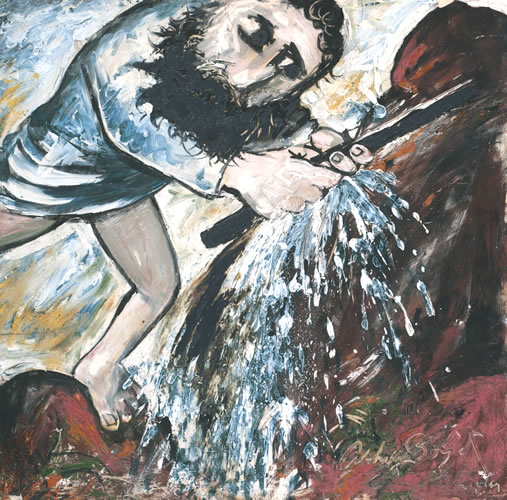
So when Moses is singing of God the Rock, like a mother of the people of Israel, in Hebrew, then why not -- given the Greek imagery elsewhere and especially in the multiply polytheistic Egypt of Alexander -- just censor out Rock and specify God when it's sung in Hellene? Why not use θεος /theos/ [or God] and not πετρας /petras/ for the Jewish maternal imagery of Moses in Deuteronomy? [UPDATE: Bob MacDonald inspires me to include some illustrations here, including one of David, with rock in sling and rod in hand, as he's getting inspired to sing, some time later, Psalm 18. I couldn't find an artist's rendering of Job's inscription, so we'll all just imagine that one. But the good point Bob's making is that the imagery is, in the mind of the translators, fairly rich.]


In summary, we hear Hellene sounding rather Hebraic and playful in Psalm 90 of Moses and definitely Hebraic though not as Greek-ish in the Deuteronomy 32 song of Moses. We suspect the translators are motivated by the sounds of their languages. But we still wonder what motivates the patriarchal censorship of some English Bible translators.
Tim Bulkeley at Sansblogue has posted on "The censored Bible: translating Psalm 90." He sees in the Hebrew of Tehillim 90, in these lyrics of Moses, what is "explicitly (I think) maternal imagery for the creation of our world." Nonetheless, as Bulkeley explicitly puts it, most English translators "censor" out the maternal from the language of Moses. "Why?"
At this blog of mine here, I'm mostly interested in why the Jews using their own Greek in Alexandria, Egypt would read their ancient Hebrew (in their scriptures) any given way. I want to first look at Tehillim 90 (renumbered πθ, or 89). Then I want to look at another hymn or psalm or song or tehillim of Moses, an earlier one in what the Septuagint renames as Deuteronomy 32.
Psalm 89 (Tehillim 90)
As we all know, for Psalm 89 (Tehillim 90), the Septuagint translators put Moses's "explicitly" maternal Hebrew into their Hellene this way:
κύριε καταφυγὴ ἐγενήθης ἡμῖν
ἐν γενεᾷ
καὶ γενεᾷ
πρὸ τοῦ ὄρη γενηθῆναι
καὶ πλασθῆναι τὴν γῆν
καὶ τὴν οἰκουμένην
καὶ ἀπὸ τοῦ αἰῶνος ἕως τοῦ αἰῶνος σὺ εἶ
Why? Is it not so explicitly maternal now? Perhaps it's very playful, rhyming words with rhythms and alliterations that we English readers don't so easily hear, if we can see some of them. Notice the punning (whether intentional or not) in the ἐγενήθης /e-genēthēnēs/ and in the repeated γενεᾷ /genea/ followed by γενηθῆναι /genēthēnai/ followed by γῆν /gēn/. But where is the γυνή /gynē/, the woman with a womb? Why is the motherly imagery censored out? Or, at the very least, why is it so implicit, so hidden in the text, so subtle?
My guess is that the translators in Egypt were being very careful. My hunch is that they knew what they were doing. My observation has been that they were resisting the Greek of Aristotle, who boxed up (his elite male-only Greek-citizen-only) language in order for him and his own to avoid ambiguities of blathering barbarisms and slippery sophistries and womanly whimsies. Our best guess is that, in most cases, the Jews in Alexander's empire, back in Egypt, were looking further back to Homer's and Hesiod's and Sappho's poetry and Euripides's plays, and to much more poetic and playful, and sometimes hilarious Hellene.
So now let's look at the song of Moses in what they call Deuternomy 32.
Deuternomy (Devarim) 32
Buckeley's comment at my other blog got me looking at and listening to Moses here. Consider these two lyrical lines of maternal imagery in Hebrew (i.e., verse 18):
צוּר יְלָדְךָ תֶּשִׁי
וַתִּשְׁכַּח אֵל מְחֹלְלֶךָ׃
Now here's that in Hebraic Hellene:
θεὸν τὸν γεννήσαντά σε ἐγκατέλιπες
καὶ ἐπελάθου θεοῦ τοῦ τρέφοντός σε.
καὶ ἐπελάθου θεοῦ τοῦ τρέφοντός σε.
Now here's that in patriarchal English bible translations:
You deserted the Rock, who fathered you;
you forgot the God who gave you birth. (NIV)
You neglected the Rock who had fathered you;
you forgot the God who had given you birth. (NLT)
(You ignored the rock who fathered you
and forgot the God who gave you life.) (God's Word®)
You have no thought for the Rock, your father,
you have no memory of the God who gave you birth. (Bible in Basic English)
Of the Rock who became your father, you are unmindful,
and have forgotten God who gave you birth. (World English Bible)
Note the difference in the Jewish English of Robert Alter:
The Rock your bearer you neglected
you forgot the God who gave you birth.
With the Christian English translations above, we quickly need to ask "Why Father?" And "why not mother?" or just (as Moses and Alter have) at least a hint of her?
With the Jewish Greek, we now need to ask "Why θεος /theos/ [or God]?" And "why not πετρας /petras/ [or Rock]?"
I really wonder whether Jesus or even if Matthew was asking the same questions of the Septuagint translators here. The name and this re-naming of Peter (i.e., the disciple of Jesus) is a clear play on the Greek. But the Jewish translators of Moses song (i.e., Deuteronomy) tend to "censor" out the word for Rock and replace it with the word for God. Why?
Now, to be clear, the Jewish translators do use the Greek word for rock in verse 13: μέλι ἐκ πέτρας καὶ ἔλαιον ἐκ στερεᾶς πέτρας. (And Alter uses similar English words for Moses' Hebrew: "honey from the crag and oil from the flinty stone.")
There are two different Hebrew "rock" words in v 13, respectively: (סֶלַע) and (צוּר). The word that Moses uses repeatedly is the latter one here. And he writes this rock word or he sings it some eight repeated times for the Divine One and for other divinities in the short context of Deuteronomy chapter 32. (See verses 4, 13, 15, 18, 30, and 31). However, in contrast, the Jewish translators of Hebrew into Hellene choose never, not even once, to use the Greek word for Rock to mark God or even gods.
Why "censor" out the maternal rock imagery?
Well, we can only guess, can't we? I think there may be some sensitivity to Moses for the translators now back, as Jews, in Egypt. I also speculate that they, being familiar with lots of Greek writings, hear some comparisons between unkosher ethnic polytheistic stories and those of Moses. They don't want either the polytheistic Egyptians or the polytheistic Greeks appropriating their Moses. They probably have watched and heard (or at least heard of) the plays of Euripides being revived and played right there in Alexandria. They've been considering how to translate Ex-Odys 17, where God commands Moses to smite the Rock; and they've been considering how to translate Numbers 20, where Moses smites the Rock in impatient disobedience to God. They're not wanting to call God "Rock" in Deuteronomy 32 (which we just looked at). Why not?
Are they being sensitive to how these stories in Greek will sound, well, so Greeky, so polytheistic Greeky?
Here's how a bit sounds from the women in Euripides's play Ion (at around 1120, as translated by Robert Potter, with Euripides's Greek interpolated back in by me):
When Creusa's husband left the god's oracular shrine, he took his new son to the feast and the sacrifice he was preparing for the god. Xuthus then went where the flame of Bacchus leaps, so that he might drench both rocks [πέτρας] of Dionysos with the slaughter, as a thank-offering for the sight of his son, and he said: "You, my child, stay here and raise a tent, fitted on both sides, by the toil of carpenters. If I should remain a long time in my sacrifice to the gods [Θεοῖσιν] of birth, set up the banquet for the friends who are there."Notice the close associations of maternal deities and the rocks for bloody sacrifices to divinities. Do the Jewish translators really want God, their maternal Rock, sounding like Διονύσου πέτρας and Γενέταις Θεοῖσιν?
And here's another bit from Euripides. It's from Bacchae (from around line 690, as translated by T. A. Buckley, again with the Greek of Euripides we're looking at together put back in):
Your mother raised a cry, standing up in the midst of the Bacchae, to wake their bodies from sleep, when she heard the lowing of the horned cattle. And they, casting off refreshing sleep from their eyes, sprang upright, a marvel of orderliness to behold, old, young, and still unmarried virgins. First they let their hair loose over their shoulders, and secured their fawn-skins, as many of them as had released the fastenings of their knots, girding the dappled hides with serpents licking their jaws. And some, holding in their arms a gazelle or wild wolf-pup, gave them white milk, as many as had abandoned their new-born infants and had their breasts still swollen. They put on garlands of ivy, and oak, and flowering yew. One took her thyrsos and struck it against a rock [πέτραν], from which a dewy stream of water sprang forth. Another let her thyrsos strike the ground, and there the god [θεός] sent forth a fountain of wine. All who desired the white drink scratched the earth with the tips of their fingers and obtained streams of milk; and a sweet flow of honey dripped from their ivy thyrsoi; so that, had you been present and seen this, you would have approached with prayers the god whom you now blame.There may be at least two problems with this Greek play for the Greek translators. First, there's this association to milk and honey, imagery of the promised land far away now from where they are back in Egypt. Second, there are Greek women, Greek mothers, doing what Moses and what God did. That is, these ethnic goyim mothers are generating, are bearing forth, are giving birth and motherly sustenance to their people in ways that might be compared with the One God and that one special servant Moses.
So when Moses is singing of God the Rock, like a mother of the people of Israel, in Hebrew, then why not -- given the Greek imagery elsewhere and especially in the multiply polytheistic Egypt of Alexander -- just censor out Rock and specify God when it's sung in Hellene? Why not use θεος /theos/ [or God] and not πετρας /petras/ for the Jewish maternal imagery of Moses in Deuteronomy? [UPDATE: Bob MacDonald inspires me to include some illustrations here, including one of David, with rock in sling and rod in hand, as he's getting inspired to sing, some time later, Psalm 18. I couldn't find an artist's rendering of Job's inscription, so we'll all just imagine that one. But the good point Bob's making is that the imagery is, in the mind of the translators, fairly rich.]
In summary, we hear Hellene sounding rather Hebraic and playful in Psalm 90 of Moses and definitely Hebraic though not as Greek-ish in the Deuteronomy 32 song of Moses. We suspect the translators are motivated by the sounds of their languages. But we still wonder what motivates the patriarchal censorship of some English Bible translators.
Friday, April 23, 2010
How to translate the word torah?
It's happened again.
Men are taking words, categorizing their meanings, and keeping them from mixing. The fear for Aristotle, as we all know by now, was that females would pollute males. Therefore, his scientific logic separated females - as botched or deformed males - from males. Likewise, the slippery words of women, if not boxed up and kept in check, would infect the world of men.
In the world of bible translation (which is far and away mostly male in 2010AD), a recent problem is the Greek word, νόμος. We can transliterate it with English letters as nómos. Wayne Leman at Better Bibles Blog separates it, as a word "in the New Testament," from "the word torah [תּוֹרָה] in the Old Testament," although he calls the one "the equivalent" of the other. The important point in the conversation there so far is the separation of the "Old Testament" from the "New Testament" and the Hebrew word from its Greek counterpart.
Wayne has pointed us to the separation Paul Franklyn has been struggling with. Franklyn is the Associate Editor for the Common English Bible translation. Franklyn gives a bit of translation history:
"The first efforts to translate torah occurred in the Greek translation of the Hebrew Bible, which is known as the Septuagint. The Septuagint was the Bible used by the Greek New Testament authors. So the Hebrew word torah was translated as the Greek word nomos, which we render as law in English. Nearly all English translations tried to be consistent and rendered "law" as the meaning of torah across the Old Testament and New Testament."
There is a tremendous point here to notice that gets overlooked by another separation of words. The point is this: that the Jews translating their own scriptures used their own Greek to render their own Hebrew. It's not so clear that they were intent on locking down the meanings of either torah [תּוֹרָה] or nómos [νόμος]. Both words have slippery meanings and wet uses. Yes, I said "wet," and we might as well say "womanly" too. But let's come back to that.
What gets overlooked is how multivalent and how polymorphic the words are in their uses and in their meanings. If we just take the Greek word nómos [νόμος], then we can begin to see the separations and the boxing up and the locking down. In English, of course, Franklyn has boxed up the word as meaning "law," at least when it comes to the Bible. Franklyn says the biblical nómos [νόμος] = "law."
Now, I'm using math symbols because men in the past have used math to claim that nómos [νόμος] = "law." No one is denying the two facts both (a) that there is such an equivalence and (b) that men have established the equivalence. Aristotle wrote of nómos [νόμος] in the context of the laws of mathematics. And his teacher Plato wrote an entire dialogue on Nómoi [Νόμοι], which has come to be called "Laws." Like his student Aristotle, Plato's project in his writing is to circumscribe the sophistry of the sophists (as he does in his dialogue "Gorgias") and to curtail the poetry of the poets (as he does in his dialogue which we know as "Republic"). Aristotle takes the separation to the Nth degree; he's not content with dialogue or, "dialectic," being able to do the job of boxing up slippery meanings. (In fact, Aristotle claims that a "rhetorician" such as Plato's Gorgias uses "rhetoric" as a counterpart to "dialectic," which Plato uses. Sophistry and poetry are nearly as slippery as women's language. This is all very technical. But that's Aristotle's point.) Women's logoi as slippery wet words needs to be separated from the logic of men.
We should be clear to say that neither Leman nor Franklyn have tried to separate women from their blogging. Neither man is bringing up gender at all. Nor is either excluding females in any way. Nonetheless, they have used the Platonic and the Aristotelian methods of separation. The Aristotelian method is one that classes but then it ranks. And the rankings, it claims, are just natural. This sort of method is the very one that classes females as inherently and naturally inferior to males. We just want to be a little careful in drawing the conclusion of such logic, if we can follow it.
So I just want to suggest that nómos [νόμος] has not always been so boxed, so technical, so legal, so related to the law of nature, to firm "law." And I also want to suggest that the Hellene of the Jews translating their Hebrew may have been a resistance to the Laws of the Greek empire. Sylvie Honigman says in her history of the legend of the Septuagint that these particular Jews translated in the Homeric (not in the Alexandrian) paradigm. Alexander, as we all know, was in the Aristotelian tradition. Alexander the Great learned from Aristotle before he set up his great Polis called Alexandria Egypt, where the translations into Greek were commissioned. I'm suggesting that the Jews there used slippery Greek, the kind that is found in the poets, such as Homer, not the legal technical Greek of Aristotle.
So we might as well hear Homer. Here's from the Iliad, book 20, lines 248 - 255. First hear Homer as Richmond Lattimore translates, then as Ian Johnston renders the words. Notice how slippery and how even wet and womanly the conversation between two men here in the Iliad threatens to be. And then listen to, and watch for the Greek (with the Greek word nómos [νόμος] bolded).
Now, go back and read Numbers 5 in the Greekish Jewish Old Testament called the Septuagint. Notice how the word torah [תּוֹרָה] has been rendered nómos [νόμος]. Notice it's associated with women differently than it's associated with men. Consider all the other uses of the same Greek word in place of the same Hebrew word throughout what is known as the Penta-Teuch, those five boxed up books of Moses. Consider how the meanings are rather opened up and not so technically shut down.
We wonder then if our English translations need to make all the distinctions, as Aristotle distinguishes males from females and logic from rhetoric and his "original" meaning from Homer's various ones. Do we need to see "New" distinguished from the "Old" testament, or nómos [νόμος] from torah [תּוֹרָה], if we don't box the words as "teaching" and, separately, as "law"?
Men are taking words, categorizing their meanings, and keeping them from mixing. The fear for Aristotle, as we all know by now, was that females would pollute males. Therefore, his scientific logic separated females - as botched or deformed males - from males. Likewise, the slippery words of women, if not boxed up and kept in check, would infect the world of men.
In the world of bible translation (which is far and away mostly male in 2010AD), a recent problem is the Greek word, νόμος. We can transliterate it with English letters as nómos. Wayne Leman at Better Bibles Blog separates it, as a word "in the New Testament," from "the word torah [תּוֹרָה] in the Old Testament," although he calls the one "the equivalent" of the other. The important point in the conversation there so far is the separation of the "Old Testament" from the "New Testament" and the Hebrew word from its Greek counterpart.
Wayne has pointed us to the separation Paul Franklyn has been struggling with. Franklyn is the Associate Editor for the Common English Bible translation. Franklyn gives a bit of translation history:
"The first efforts to translate torah occurred in the Greek translation of the Hebrew Bible, which is known as the Septuagint. The Septuagint was the Bible used by the Greek New Testament authors. So the Hebrew word torah was translated as the Greek word nomos, which we render as law in English. Nearly all English translations tried to be consistent and rendered "law" as the meaning of torah across the Old Testament and New Testament."
There is a tremendous point here to notice that gets overlooked by another separation of words. The point is this: that the Jews translating their own scriptures used their own Greek to render their own Hebrew. It's not so clear that they were intent on locking down the meanings of either torah [תּוֹרָה] or nómos [νόμος]. Both words have slippery meanings and wet uses. Yes, I said "wet," and we might as well say "womanly" too. But let's come back to that.
What gets overlooked is how multivalent and how polymorphic the words are in their uses and in their meanings. If we just take the Greek word nómos [νόμος], then we can begin to see the separations and the boxing up and the locking down. In English, of course, Franklyn has boxed up the word as meaning "law," at least when it comes to the Bible. Franklyn says the biblical nómos [νόμος] = "law."
Now, I'm using math symbols because men in the past have used math to claim that nómos [νόμος] = "law." No one is denying the two facts both (a) that there is such an equivalence and (b) that men have established the equivalence. Aristotle wrote of nómos [νόμος] in the context of the laws of mathematics. And his teacher Plato wrote an entire dialogue on Nómoi [Νόμοι], which has come to be called "Laws." Like his student Aristotle, Plato's project in his writing is to circumscribe the sophistry of the sophists (as he does in his dialogue "Gorgias") and to curtail the poetry of the poets (as he does in his dialogue which we know as "Republic"). Aristotle takes the separation to the Nth degree; he's not content with dialogue or, "dialectic," being able to do the job of boxing up slippery meanings. (In fact, Aristotle claims that a "rhetorician" such as Plato's Gorgias uses "rhetoric" as a counterpart to "dialectic," which Plato uses. Sophistry and poetry are nearly as slippery as women's language. This is all very technical. But that's Aristotle's point.) Women's logoi as slippery wet words needs to be separated from the logic of men.
We should be clear to say that neither Leman nor Franklyn have tried to separate women from their blogging. Neither man is bringing up gender at all. Nor is either excluding females in any way. Nonetheless, they have used the Platonic and the Aristotelian methods of separation. The Aristotelian method is one that classes but then it ranks. And the rankings, it claims, are just natural. This sort of method is the very one that classes females as inherently and naturally inferior to males. We just want to be a little careful in drawing the conclusion of such logic, if we can follow it.
So I just want to suggest that nómos [νόμος] has not always been so boxed, so technical, so legal, so related to the law of nature, to firm "law." And I also want to suggest that the Hellene of the Jews translating their Hebrew may have been a resistance to the Laws of the Greek empire. Sylvie Honigman says in her history of the legend of the Septuagint that these particular Jews translated in the Homeric (not in the Alexandrian) paradigm. Alexander, as we all know, was in the Aristotelian tradition. Alexander the Great learned from Aristotle before he set up his great Polis called Alexandria Egypt, where the translations into Greek were commissioned. I'm suggesting that the Jews there used slippery Greek, the kind that is found in the poets, such as Homer, not the legal technical Greek of Aristotle.
So we might as well hear Homer. Here's from the Iliad, book 20, lines 248 - 255. First hear Homer as Richmond Lattimore translates, then as Ian Johnston renders the words. Notice how slippery and how even wet and womanly the conversation between two men here in the Iliad threatens to be. And then listen to, and watch for the Greek (with the Greek word nómos [νόμος] bolded).
The tongue of man is a twisty thing, there are plenty of words there
of every kind, the range of words is wide, and their variance.
The sort of thing you say is the thing that will be said to you.
But what have you and I to do with the need for squabbling
and hurling insults at each other, as if we were two wives
who when they have fallen upon a heart-perishing quarrel
go out in the street and say abusive things to each other,
much true, and much that is not, and it is their rage that drives them.
Men's tongues are glib, with various languages—
words can go here and there in all directions,
and the sorts of words one speaks will be
the sorts of words one has to listen to.
But what's the point? Why should the two of us
be squabbling here and fight by trading insults
back and forth, like two irritated women,
who, in some heart-wrenching raging spat,
go out into the street to scream at each other
with facts and lies, each one gripped by anger.
στρεπτὴ δὲ γλῶσσ' ἐστὶ βροτῶν, πολέες δ' ἔνι μῦθοι
παντοῖοι, ἐπέων δὲ πολὺς νομὸς ἔνθα καὶ ἔνθα.
ὁπποῖόν κ' εἴπῃσθα ἔπος, τοῖόν κ' ἐπακούσαις.
ἀλλὰ τίη ἔριδας καὶ νείκεα νῶϊν ἀνάγκη
νεικεῖν ἀλλήλοισιν ἐναντίον ὥς τε γυναῖκας,
αἵ τε χολωσάμεναι ἔριδος πέρι θυμοβόροιο
νεικεῦσ' ἀλλήλῃσι μέσην ἐς ἄγυιαν ἰοῦσαι
πόλλ' ἐτεά τε καὶ οὐκί: χόλος δέ τε καὶ τὰ κελεύει
Now, go back and read Numbers 5 in the Greekish Jewish Old Testament called the Septuagint. Notice how the word torah [תּוֹרָה] has been rendered nómos [νόμος]. Notice it's associated with women differently than it's associated with men. Consider all the other uses of the same Greek word in place of the same Hebrew word throughout what is known as the Penta-Teuch, those five boxed up books of Moses. Consider how the meanings are rather opened up and not so technically shut down.
We wonder then if our English translations need to make all the distinctions, as Aristotle distinguishes males from females and logic from rhetoric and his "original" meaning from Homer's various ones. Do we need to see "New" distinguished from the "Old" testament, or nómos [νόμος] from torah [תּוֹרָה], if we don't box the words as "teaching" and, separately, as "law"?
Saturday, April 10, 2010
Who do you think one must be first: a womanist's question
.
"Who do you think one must read first in order to understand the Bible?" - this is John F. Hobbin's question at the end of his blogpost in which he gives his answer. He's said earlier and elsewhere, "My kids at their public high school get a taste of Shakespeare by a teacher who has no love for Shakespeare, who thinks Maya Angelou is better, which is still better than nothing, but NO Milton." He's quoted one of his teachers, saying, "I don’t think you can understand the Bible unless you’ve read Ovid, Milton, and Blake first." These men, white men of privilege, are his necessary "triad."
And all of this got me thinking, this morning, as I read the Greek (septuagint) translation of what we call Psalm 8. It got me thinking of how so much of the reception of the Bible is in terms of men, and of men of majority race, and of men of majority race and class.
When I was writing it, the person on my dissertation committee who is an expert on Greek language and who is also a scholar on Mediterranean household codes written in Greek is also a person who has often pointed out something strange about the bible. (She's a feminist but would acknowledge is not a womanist. Her name is Carolyn Osiek). The strange thing she's pointed out is this: the New Testament, written in Greek around the Mediterranean, has household codes that regulate women and slaves, as if women are not slaves and slaves are not women, and as if the two disparaged groups need separate instructions. So there's biblical silence on the rights and responsibilities or (shall we call them what they are?) the expectations of a person who is (1) a female and is of (2) a lower class of (3) a darker skin color and is, therefore also, a slave.
Now, that's a triad.
How would she read Κύριε ὁ κύριος ἡμῶν / Kurie ho kurios hemon/? "Master, that master of ours"
How could she read ἐκ στόματος νηπίων καὶ θηλαζόντων κατηρτίσω αἶνον /ek sotmatos nepion kai thelazonton katertiso ainon/? "out of the mouth of babes and those nursing their mothers is praise" for You
How should she read
τί ἐστιν ἄνθρωπος, ὅτι μιμνῄσκῃ αὐτοῦ,
ἢ υἱὸς ἀνθρώπου, ὅτι ἐπισκέπτῃ αὐτόν;
/ti estin anthropos, hoti mimneske autou,
h hios anthropou, hoti episkepte auton/
"what is a mortal, that it's remembered by You,
or a Son of a human, that You visit Him?" ?
These are questions, her questions. They sound from outside, sound like Gayl Jones. She's not even a feminist, perhaps. She writes re-membering. She is visited, but it's like a haunting. She writes, remembering Corregidora. If you're Milton and not Maya Angelou, then there's nothing to explain. The apostle Paul read Psalm 8 in the Greek once, and he didn't have to give any explanation for it. Womanists (not sons, not white, not of a high class or race or gender) must answer, or must they?
My question is "Who do you think one must be first in order to understand the Bible?"
"Who do you think one must read first in order to understand the Bible?" - this is John F. Hobbin's question at the end of his blogpost in which he gives his answer. He's said earlier and elsewhere, "My kids at their public high school get a taste of Shakespeare by a teacher who has no love for Shakespeare, who thinks Maya Angelou is better, which is still better than nothing, but NO Milton." He's quoted one of his teachers, saying, "I don’t think you can understand the Bible unless you’ve read Ovid, Milton, and Blake first." These men, white men of privilege, are his necessary "triad."
And all of this got me thinking, this morning, as I read the Greek (septuagint) translation of what we call Psalm 8. It got me thinking of how so much of the reception of the Bible is in terms of men, and of men of majority race, and of men of majority race and class.
When I was writing it, the person on my dissertation committee who is an expert on Greek language and who is also a scholar on Mediterranean household codes written in Greek is also a person who has often pointed out something strange about the bible. (She's a feminist but would acknowledge is not a womanist. Her name is Carolyn Osiek). The strange thing she's pointed out is this: the New Testament, written in Greek around the Mediterranean, has household codes that regulate women and slaves, as if women are not slaves and slaves are not women, and as if the two disparaged groups need separate instructions. So there's biblical silence on the rights and responsibilities or (shall we call them what they are?) the expectations of a person who is (1) a female and is of (2) a lower class of (3) a darker skin color and is, therefore also, a slave.
Now, that's a triad.
How would she read Κύριε ὁ κύριος ἡμῶν / Kurie ho kurios hemon/? "Master, that master of ours"
How could she read ἐκ στόματος νηπίων καὶ θηλαζόντων κατηρτίσω αἶνον /ek sotmatos nepion kai thelazonton katertiso ainon/? "out of the mouth of babes and those nursing their mothers is praise" for You
How should she read
τί ἐστιν ἄνθρωπος, ὅτι μιμνῄσκῃ αὐτοῦ,
ἢ υἱὸς ἀνθρώπου, ὅτι ἐπισκέπτῃ αὐτόν;
/ti estin anthropos, hoti mimneske autou,
h hios anthropou, hoti episkepte auton/
"what is a mortal, that it's remembered by You,
or a Son of a human, that You visit Him?" ?
These are questions, her questions. They sound from outside, sound like Gayl Jones. She's not even a feminist, perhaps. She writes re-membering. She is visited, but it's like a haunting. She writes, remembering Corregidora. If you're Milton and not Maya Angelou, then there's nothing to explain. The apostle Paul read Psalm 8 in the Greek once, and he didn't have to give any explanation for it. Womanists (not sons, not white, not of a high class or race or gender) must answer, or must they?
My question is "Who do you think one must be first in order to understand the Bible?"
Thursday, March 18, 2010
Who Says Homosexuality is a Sin?
This is a question Joel Hoffman has asked. And the answer is: "The NLT does, right there in its 'translation' to Leviticus 18:22."
"Do not practice homosexuality; it is a detestable sin."
Hoffman goes on to say "that’s not what the Hebrew says" and explains how "what the NLT has here is an interpretation, not a translation."
I think how translator Robert Alter translates and how he explains is also useful:
With a male you shall not lie as one lies with a woman. It is an abhorrence.
καὶ μετὰ ἄρσενος οὐ κοιμηθήσῃ κοίτην γυναικός βδέλυγμα γάρ ἐστιν
Is Alter's translation a myopic one? Is the Greek translation, if it's a translation, a myopic one? Isn't the NLT something else altogether (committing what Alter calls the "heresy of explanation" as if the explanation is a good one)?
I'm out of time for now, but as always am interested in what you see and how you feel about these sorts of things.
"Do not practice homosexuality; it is a detestable sin."
Hoffman goes on to say "that’s not what the Hebrew says" and explains how "what the NLT has here is an interpretation, not a translation."
I think how translator Robert Alter translates and how he explains is also useful:
With a male you shall not lie as one lies with a woman. It is an abhorrence.
The explicitness of this law–the Hebrew for ‘as one lies’ is the plural construct noun mishkevei, ‘bedding,’ used exclusively for sexual intercourse–suggests that it is a ban on intercourse and intercrural intercourse (the latter often practiced by the Greeks). Other forms of homosexual activity do not seem of urgent concern. The evident rationale for the prohibition is the wasting of seed in what the law appears to envisage as a kind of grotesque parody of heterosexual intercourse [i.e., for procreation primarily?]. (Lesbianism, which surely must have been known in the ancient Near East, is nowhere mentioned, perhaps because of no wasting of seed is involved, though the reason for the omission remains unclear). There is scant textual evidence to support the apologetic claim of some recent interpreters that the ban on homosexual congress is limited to the preceding list of incestuous unions. One may apply here the proposal of Mary Douglas that this is a culture that likes to keep lines of categorical distinction clear: no human-beast couplings are allowed (in contrast to the imaginative freedom on this topic of Greek myth), and any simulation of procreative heterosexual intercourse by the insertion of the male member in an orifice or fleshy crevice of another male is abhorrent.Now, here's the Hebrew (at least it's the MT). And then with all that Greek talk, we might compare the Greek (remembering how Aristotle, or at least a pseudo-sound-alike Aristotle used the word βδελυροὶ to express his disgust when discussing the shapes of women's body parts when they are unshapely and when they compare by his objective standard, sometimes, to κίναιδοι, or "catamites"):
וְאֶת־זָכָר לֹא תִשְׁכַּב מִשְׁכְּבֵי אִשָּׁה תֹּועֵבָה הִוא׃
καὶ μετὰ ἄρσενος οὐ κοιμηθήσῃ κοίτην γυναικός βδέλυγμα γάρ ἐστιν
Is Alter's translation a myopic one? Is the Greek translation, if it's a translation, a myopic one? Isn't the NLT something else altogether (committing what Alter calls the "heresy of explanation" as if the explanation is a good one)?
I'm out of time for now, but as always am interested in what you see and how you feel about these sorts of things.
Friday, February 26, 2010
Of women and -μένη
.
Well, quite unrelated (probably) is the "present participle, feminine singular nominative, of the middle or passive voice of" two other Greek verbs I found. Each has the suffix -μένη.
I don't really have time to say much of what I think about this, but I'd certainly welcome any comments. The main thing to note, of course, is the wordplay here.
The Greek is a playful translating of Hebrew. And the Hebrew seems full of wordplay (if the Masoretic text is what was being translated). So here it is. Please tell me what you see, and I promise as time allows to come back to talk with you and to make of it anything else we might see together.
Leviticus 21:7 and 21:14 (ΛΕΥΕΙΤΟΚΟΝ / ויקרא)
γυναῖκα πόρνην καὶ βεβηλωμένην οὐ λήμψονται καὶ γυναῖκα ἐκβεβλημένην ἀπὸ ἀνδρὸς αὐτῆς ἅγιός ἐστιν τῷ κυρίῳ θεῷ αὐτοῦ
χήραν δὲ καὶ ἐκβεβλημένην καὶ βεβηλωμένην καὶ πόρνην ταύτας οὐ λήμψεται ἀλλ᾽ ἢ παρθένον ἐκ τοῦ γένους αὐτοῦ λήμψεται γυναῖκα
אִשָּׁה זֹנָה וַחֲלָלָה לֹא יִקָּחוּ וְאִשָּׁה גְּרוּשָׁה מֵאִישָׁהּ לֹא יִקָּחוּ כִּֽי־קָדֹשׁ הוּא לֵאלֹהָֽיו׃
אַלְמָנָה וּגְרוּשָׁה וַחֲלָלָה זֹנָה אֶת־אֵלֶּה לֹא יִקָּח כִּי אִם־בְּתוּלָה מֵעַמָּיו יִקַּח אִשָּֽׁה׃
Here's Lancelot Brenton's solo translation of the Greek into English followed by Julia E. Smith's solo translation of the Hebrew into English (both completed in the nineteenth century):
They shall not take a woman who is a harlot and profaned, or a woman put away from her husband; for he is holy to the Lord his God.
But a widow, or one that is put away, or profaned, or a harlot, these he shall not take; but he shall take for a wife a virgin of his own people.
They shall not take a woman, harlot, or profane; and they shall not take a wife driven away from her husband, for he is holy to his God.
A widow, and the driven away, and profane, and an harlot, these he shall not take: but a virgin of his people shall he take a wife.
Why these translations? What motivates the Hebrew, the Hellene translation? How do they mirror one another, and in what way do they play with interpretation and with performance and with playfulness in different ways?
.
Saturday, January 23, 2010
Pentateuch as translation
What's the Pentateuch? Transliteration (i.e., the foreign language spelling of the sounds of the original word) robs us of some of the wordplay, the gendered qualities of the word. It's the Hellene (or Greek) translation of the Hebrew חומש - which somebody's entry in the Encyclopedia of Judaism explains as "the ḥumash (from the root ḥ-m-sh, meaning 'five')." The reference is to the first five "books" of the Bible, aka "the five books of Moses." When the Jews in Alexandria Egypt translated these books, then they also translated the Hebrew word as Πεντάτευχος [Pentáteuchos], which is the phrase "πεντά τευχος." Πεντά is Hellene for "five." So what is the Hellene τευχος? Is it "books"?
In much of Greek literature, τευχος refers to "vessels" or "pitchers" or "containers." And most of the time, these vessels are related to women. An interesting word choice for translation, don't you think? Why not "Πεντάβιβλία [Pentabiblía]" (or literally "five books") for the Hebrew חומש referring to the "five books"?
Here's a couple of the Greek phrases (and English translations by a couple of translators):
Of course, the Hellene word means other things not always related to women. And yet, the discussion around and after Suzanne's post Temple Vessels has me thinking about "women" and "vessels" and Jewish men's Greek word choices for them.
In much of Greek literature, τευχος refers to "vessels" or "pitchers" or "containers." And most of the time, these vessels are related to women. An interesting word choice for translation, don't you think? Why not "Πεντάβιβλία [Pentabiblía]" (or literally "five books") for the Hebrew חומש referring to the "five books"?
Here's a couple of the Greek phrases (and English translations by a couple of translators):
I have heard that the maidens opened the vessel of the goddess.Both the passages are from Euripides' plays. The first has Ion speaking in "Ion," and the second has Helen speaking in the play "Helen."
ἤκουσα λῦσαι παρθένους τεῦχος θεᾶς
For no other woman, Hellene or barbarian,
gives birth to a white vessel of chicks,
in which they say Leda bore me to Zeus.
γυνὴ γὰρ οὔθ’ Ἑλληνὶς οὔτε βάρβαρος
τεῦχος νεοσσῶν λευκὸν ἐκλοχεύεται,
ἐν ᾧ με Λήδαν φασὶν ἐκ Διὸς τεκεῖν
Of course, the Hellene word means other things not always related to women. And yet, the discussion around and after Suzanne's post Temple Vessels has me thinking about "women" and "vessels" and Jewish men's Greek word choices for them.
Monday, December 28, 2009
Wordplay of Ruth
While pondering whether to blog here in 2010, I re-read the following towards the end of 2009.
It's from מגילת רות, the "Scroll of Ruth" (chapter 1, verse 14). In the story, it's the second explicit mention of the names of the daughters-in-law of Naomi. The first mention, of course, has the two women named in relation to their men, their husbands (in verse 4). The men are Naomi's sons, who die and leave the two younger women alone as widows; Naomi cries that she cannot replace them because she's too old to bear more sons in her womb. The significance of the women, and their names perhaps, seems implicit in their need to conceive and to produce male babies. But in 14, the names have significance, feminine significances, beyond the men. There is a literary significance, a wordplay, to get at other realities for the women. It comes out also in the Hellene translation from the Hebrew, though the play is in different directions.
So let's come back to possible meanings of the names of the two younger women in Hebrew, and then look at how this plays in Greek (i.e., Hellene). The name "Orpah" (עָרְפָּה) seems to have significance in physical appearance and means something like "bangs" or "forelock" or "mane" - perhaps as a female deer or gazelle might have. The name "Ruth" (רוּת) seems to have significance physical appearance but may also have significance in character or relationship; the name, ambiguously, means something like "beauty" or "good looking" and also "friend." These are Hebrew words for foreign women, for non-Jews who are also females. When "translated" by Jewish men into Hellene, the words are simply transliterated, so that the Hebrew sounds are retained when you read the Greek: Ορφα and Ρουθ. If you are not a Hebrew speaking Jew who is a male, then the significance of the words, even their sounds, is lost in transliteration.
Now, if you go back to re-read verses 4 and 14 with the names actually translated (and not just transliterated), then it goes something like this in English:
But "Ruth," or Good-looking Friend, does something different, something unexpected. She does what a young nuptial will do. She leaves her home to cleave to a husband. This is reminiscent of Genesis 2:24, a pronouncement of the pattern of a man and a woman cleaving (דָּבַק) together as one flesh. The friendly thing this young woman does is to cleave to the mother of her dead husband. There is much more here. Much more is here theologically and racially and with respect to gender.
And in the Greek translation there's much more too. So let's leave the theology and the race question and the issues of sex to turn our focus to the translating.
The Hellene (i.e. Septuagint) rendering of verse 14 is as follows:
But the word used for "following after" smacks (*post-Aristotle) of a social hierarchy of wife under and after a husband, a kind of submissiveness. And the translators are using a very ironic Greek language to show how striking Ruth's decision in contrast to her sister's. These are, by the way, foreign females. The translators are also rendering the old Hebrew as very foreign (in Alexander-the-Great's city Alexandria). They're nearly reversing which sister is "the friend" but are retaining the striking idea that this "Ruth" is following after (as if cleaving to) a mother-in-law the way Hebrew women would normally cleave to Jewish men (so that more male children could be born).
(The New Testament represents Ruth as a foreign fore-mother of the Messiah, Joshua of Nazareth, as the "son" of David, who is the "son" of Ruth. The patrilineage to open Matthew's gospel is interrupted by Ruth. At the end of the gospel of Matthew, the "kiss" is used to signify the betrayal of this Joshua by Judah, who won't follow after this Messiah. In this way, the Greek translation of Ruth finds a parallel in the gospel of Matthew. Of course, it's not likely that Matthew writing meant for the parallel. What I'm noticing, nonetheless, and trying to suggest, is there are reversals and ironies and meanings made in the "Scrolls of Ruth" and its Hebrew-Hellene translation).
-----
*So, just to illustrate what Aristotle sets up as the "following after" hierarchy, here's a bit from his Politics (around 1035b, with H. Rackham translating into English) --
וַתִּשֶּׂנָה קוֹלָן
וַתִּבְכֶּינָה עוֹד
וַתִּשַּׁק עָרְפָּה לַחֲמוֹתָהּ
וְרוּת דָּבְקָה בָּהּ
It's from מגילת רות, the "Scroll of Ruth" (chapter 1, verse 14). In the story, it's the second explicit mention of the names of the daughters-in-law of Naomi. The first mention, of course, has the two women named in relation to their men, their husbands (in verse 4). The men are Naomi's sons, who die and leave the two younger women alone as widows; Naomi cries that she cannot replace them because she's too old to bear more sons in her womb. The significance of the women, and their names perhaps, seems implicit in their need to conceive and to produce male babies. But in 14, the names have significance, feminine significances, beyond the men. There is a literary significance, a wordplay, to get at other realities for the women. It comes out also in the Hellene translation from the Hebrew, though the play is in different directions.
So let's come back to possible meanings of the names of the two younger women in Hebrew, and then look at how this plays in Greek (i.e., Hellene). The name "Orpah" (עָרְפָּה) seems to have significance in physical appearance and means something like "bangs" or "forelock" or "mane" - perhaps as a female deer or gazelle might have. The name "Ruth" (רוּת) seems to have significance physical appearance but may also have significance in character or relationship; the name, ambiguously, means something like "beauty" or "good looking" and also "friend." These are Hebrew words for foreign women, for non-Jews who are also females. When "translated" by Jewish men into Hellene, the words are simply transliterated, so that the Hebrew sounds are retained when you read the Greek: Ορφα and Ρουθ. If you are not a Hebrew speaking Jew who is a male, then the significance of the words, even their sounds, is lost in transliteration.
Now, if you go back to re-read verses 4 and 14 with the names actually translated (and not just transliterated), then it goes something like this in English:
4 And they took them wives of the women of Moab: the name of the one was "Doe with Bangs," and the name of the other "Good-looking Friend"; and they dwelt there about ten years.
14 And they lifted up their voice, and wept again; and "Doe with Bangs" kissed her mother-in-law; but "Good-looking Friend" cleaved unto her.The significances (or the wordplay) in the names seem to come out strongly in verse 14. (By wordplay I mean not only playfulness but also interpretative play or wiggle room.) Doe-with-Bangs ("Orpah") kisses her mother-in-law. The kiss is reminiscent of what Naomi had already done to both young women in verse 9. There, the mother-in-law is not only comforting them in their grief but she is also giving them a patriarchal blessing. That is, Naomi is pronouncing God's kindness and rest on the widows provided they return to find men who will marry and impregnate them. They are to be fruitful and to multiply by bearing male babies, by giving birth to sons. When Doe-with-Bangs kisses her mother-in-law, she is signaling that she will return (perhaps as gracefully as a running deer to the young bucks at home).
But "Ruth," or Good-looking Friend, does something different, something unexpected. She does what a young nuptial will do. She leaves her home to cleave to a husband. This is reminiscent of Genesis 2:24, a pronouncement of the pattern of a man and a woman cleaving (דָּבַק) together as one flesh. The friendly thing this young woman does is to cleave to the mother of her dead husband. There is much more here. Much more is here theologically and racially and with respect to gender.
And in the Greek translation there's much more too. So let's leave the theology and the race question and the issues of sex to turn our focus to the translating.
The Hellene (i.e. Septuagint) rendering of verse 14 is as follows:
καὶ ἐπῆραν τὴν φωνὴν αὐτῶνRoughly, we could re-present that in English as follows:
καὶ ἔκλαυσαν ἔτι
καὶ κατεφίλησεν Ορφα τὴν πενθερὰν αὐτῆς
καὶ ἐπέστρεψεν εἰς τὸν λαὸν αὐτῆς
Ρουθ δὲ ἠκολούθησεν αὐτῇ
And they raised up their voicesIn Greek, the word used for "kissing" is a word that also signifies "friendship."
And they cried out continually
And Orpah like a friend kissed her mother-in-law
And returned to her people.
Ruth, however, followed after her
But the word used for "following after" smacks (*post-Aristotle) of a social hierarchy of wife under and after a husband, a kind of submissiveness. And the translators are using a very ironic Greek language to show how striking Ruth's decision in contrast to her sister's. These are, by the way, foreign females. The translators are also rendering the old Hebrew as very foreign (in Alexander-the-Great's city Alexandria). They're nearly reversing which sister is "the friend" but are retaining the striking idea that this "Ruth" is following after (as if cleaving to) a mother-in-law the way Hebrew women would normally cleave to Jewish men (so that more male children could be born).
(The New Testament represents Ruth as a foreign fore-mother of the Messiah, Joshua of Nazareth, as the "son" of David, who is the "son" of Ruth. The patrilineage to open Matthew's gospel is interrupted by Ruth. At the end of the gospel of Matthew, the "kiss" is used to signify the betrayal of this Joshua by Judah, who won't follow after this Messiah. In this way, the Greek translation of Ruth finds a parallel in the gospel of Matthew. Of course, it's not likely that Matthew writing meant for the parallel. What I'm noticing, nonetheless, and trying to suggest, is there are reversals and ironies and meanings made in the "Scrolls of Ruth" and its Hebrew-Hellene translation).
-----
*So, just to illustrate what Aristotle sets up as the "following after" hierarchy, here's a bit from his Politics (around 1035b, with H. Rackham translating into English) --
For a man's [or a husband's] acts can no longer be noble if he does not excel as greatly as a man excels a woman [or a husband excels a wife] or a father his children or a master his slaves, so that one who transgresses cannot afterwards achieve anything sufficient to rectify the lapse from virtue that he had already committed; because for equals the noble and just consists in their taking turns, since this is equal and alike, but for those that are equal to have an unequal share and those that are alike an unlike share is contrary to nature, and nothing contrary to nature is noble. Hence in case there is another person who is our superior in virtue and in practical capacity for the highest functions, him it is noble to follow [ἀκολουθεῖν] and him it is just to obey; though he must possess not only virtue but also capacity that will render him capable of action.
Subscribe to:
Posts (Atom)